
Answer first
Media leakage occurs when advertising successfully creates consumer demand but part of the resulting economic value is captured outside the brand's intended commercial system. The media may have worked. The brand still may not receive the sale, the margin, or the customer value it expected.
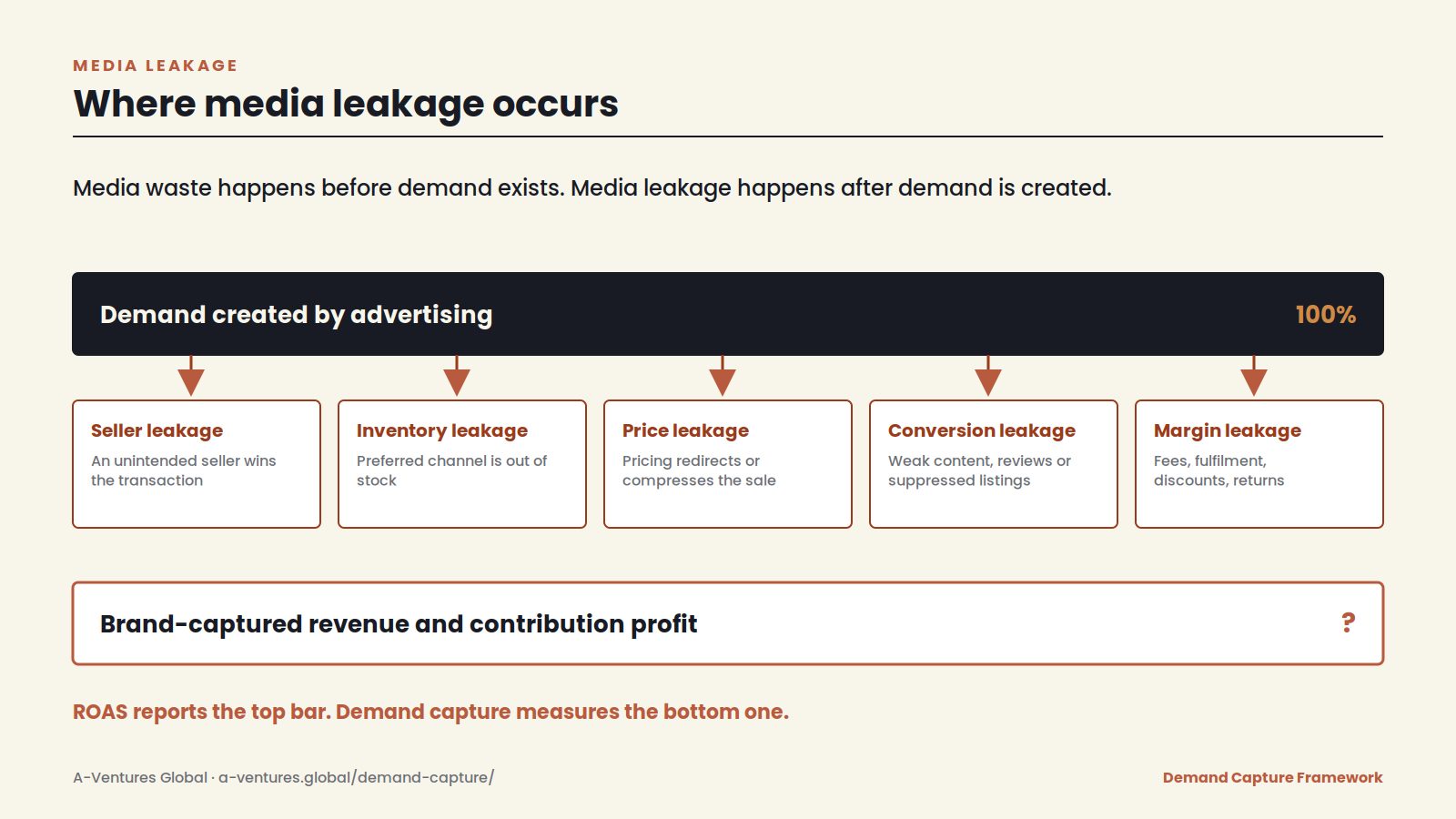
Media waste and media leakage are not the same
Media waste occurs when advertising fails to create useful demand. Media leakage occurs after demand has been created. A shopper may see an ad, become interested, search for the product and buy. The problem is that the purchase may go to the wrong seller, the wrong channel, an out-of-policy price, or an economically unattractive fulfillment path.
This distinction matters because traditional media optimization can improve the first problem while missing the second. Better targeting, creative and bidding can reduce wasted impressions. They do not automatically ensure that the brand controls the transaction created by those impressions.
Where media leakage occurs
Media leakage can occur at several points between the impression and the final economic result.
- Seller leakage: an unauthorized or unintended third-party seller wins the transaction after branded demand is created.
- Inventory leakage: the preferred seller or channel is out of stock, so the shopper shifts to another seller, retailer, substitute product or competitor.
- Price leakage: inconsistent pricing or promotions redirect the transaction to a less attractive channel or compress margin.
- Conversion leakage: poor content, weak reviews, suppressed listings or missing product information reduce the brand's ability to monetize traffic.
- Margin leakage: attributed revenue grows, but discounting, fulfillment expense, marketplace fees, returns or channel mix reduce contribution profit.
Why ROAS can hide leakage
ROAS is useful for understanding the relationship between attributed sales and advertising spend. It is not a complete measure of commercial capture. A campaign can report strong attributed marketplace sales while a meaningful share of units are sold by third parties. It can also report strong revenue while the product mix, fulfillment costs or promotions produce weak contribution economics.
The relevant executive question is therefore not only "What sales did the media influence?" It is "What share of the economic value created by the media was captured by the brand, through the intended channel, at acceptable margin?" That is the case for measuring contribution profit alongside ROAS.
How to measure media leakage
There is no universal accounting standard for media leakage, so brands should define a practical operating measure. Start with the demand you can observe or reasonably estimate, then reconcile that demand with authorized brand-captured transactions.
A basic framework is: estimated demand influenced by the campaign; minus transactions captured by unintended sellers or channels; minus demand lost to availability, content or pricing failures; then compare the remaining brand-captured revenue and contribution profit with the original media investment.
The measure will never be perfect. The objective is management visibility, not false precision.
A pre-campaign leakage check
Before increasing spend behind a product, answer five questions: who currently wins the purchase position; is the intended inventory in stock; are unauthorized sellers present; is pricing aligned across major channels; and is the product detail experience ready to convert incremental traffic?
If the answer to any of these questions is weak, increasing media can magnify an existing commercial-control problem. The full version of this check is the Demand Capture Audit, and the conditions it tests are described under marketplace readiness.
Media leakage should be a CMO and CFO issue
Media leakage sits between organizational functions, which is why it often persists. Marketing sees traffic and attributed sales. Ecommerce sees marketplace operations. Sales sees channel relationships. Finance sees margin after the fact. None of those views alone explains where the value escaped.
A leakage framework creates a shared language. The CMO can ask whether demand is being monetized. The CFO can ask whether it is profitable. The ecommerce team can identify the operating fixes needed before the next dollar of media is deployed.
From media optimization to value capture
The larger strategic implication is that advertising effectiveness should extend beyond demand creation. As agencies and holding companies move deeper into commerce, the next layer of differentiation will come from connecting media decisions to seller control, inventory, pricing, channel economics and contribution profit.
A-Ventures uses media leakage as a diagnostic concept inside the broader discipline of demand capture. The goal is not to reduce advertising. It is to ensure that advertising works for the brand all the way through the transaction.
Frequently asked questions
Media leakage is the loss of economic value after advertising successfully creates consumer demand but the brand does not fully capture the resulting transaction or margin.
Yes. Attributed sales can be strong even when third-party sellers capture transactions, the preferred channel is out of stock, or the resulting sales generate weak contribution profit.
Brand-funded advertising can increase product demand that unauthorized sellers then monetize if they control the purchase position or offer more attractive availability or pricing.
Connect media planning to seller monitoring, inventory availability, marketplace readiness, pricing and contribution economics before and during campaigns.
Sources and further reading
Related
Part of the A-Ventures demand capture framework. See also: commercial leakage, channel control, marketplace readiness, contribution profit.
Work with A-Ventures on demand capture
The Demand Capture Ledger measures, at the SKU level, how much of the demand your advertising creates is captured by the authorized channel, dollarizes the leakage, and deploys the fix. It is delivered by Equity Commerce, an authorized WPP service provider, inside your existing agency relationship. Name a client and a category and we will bring the numbers.