
Answer first
Ecommerce channel control is the discipline of managing who sells a brand's products, where those products are sold, at what price and with what inventory, content and fulfillment standards. Its purpose is not to restrict commerce for its own sake. It is to make distribution consistent with the brand's growth, margin and customer-experience strategy.
Why channel control is now a marketing issue
In physical distribution, channel decisions were traditionally owned by sales, distribution and legal teams. Marketplaces changed the economics. A consumer exposed to paid media can move immediately into an environment where multiple sellers compete to capture the resulting purchase.
That means seller ownership and availability can influence advertising effectiveness. If the brand funds demand but an unintended seller wins the transaction, the media has created consumer value without guaranteeing brand economic capture. That is the seller form of media leakage.
The components of channel control
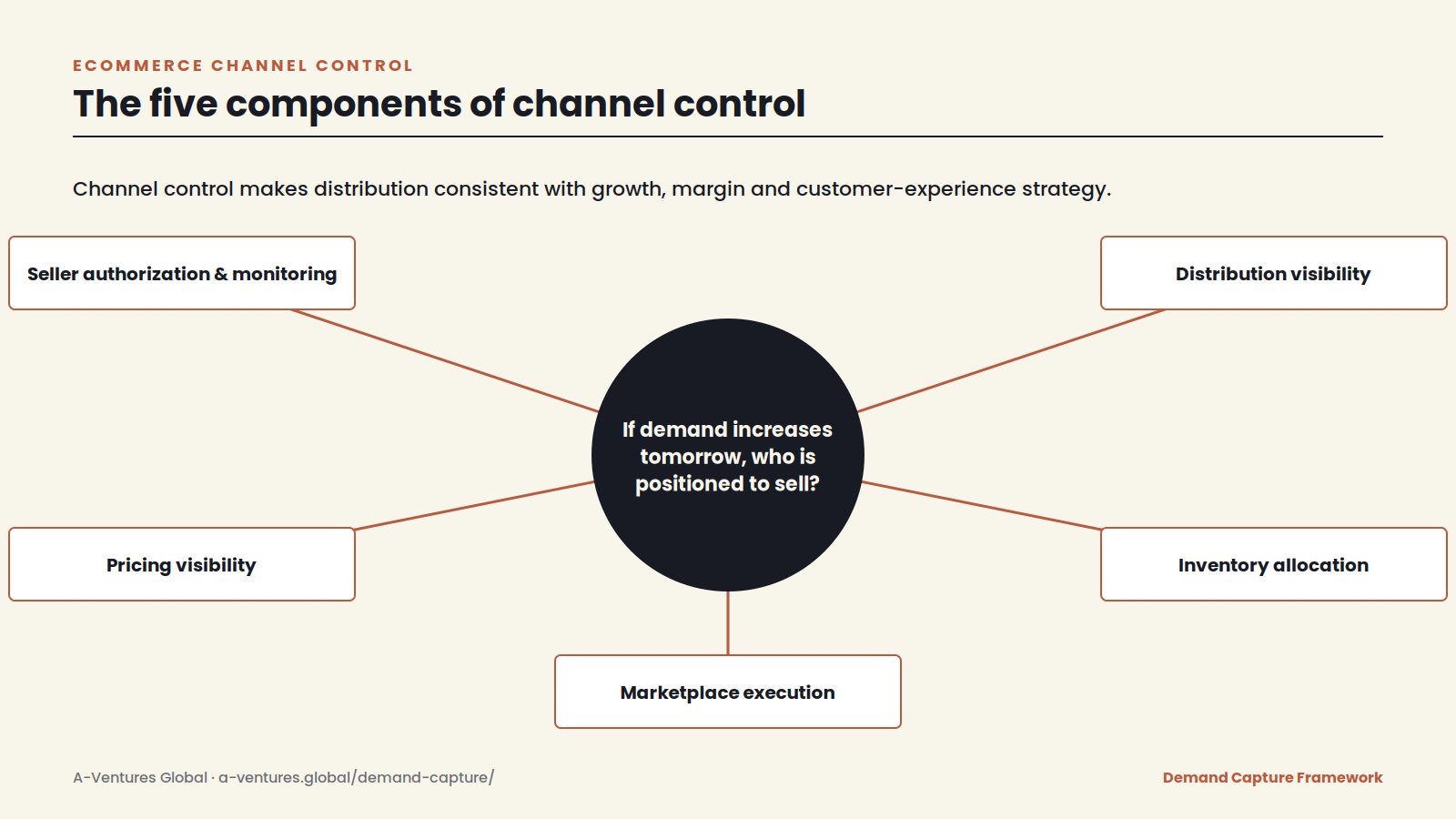
A complete channel-control program connects five elements.
- Seller authorization and monitoring: know which sellers are intended to carry the product and detect material deviations.
- Distribution visibility: understand how inventory reaches marketplaces, retailers and resellers.
- Pricing visibility: identify material price differences that change shopper behavior or damage channel economics.
- Inventory allocation: maintain stock in the channels and seller accounts expected to receive demand.
- Marketplace execution: ensure the intended offer is competitive, compliant, discoverable and conversion-ready; see marketplace readiness.
Unauthorized sellers are a commercial problem before they are a legal problem
Brands often treat unauthorized sellers primarily as an enforcement issue. The first management question should be economic: what effect are these sellers having on demand capture, price realization, inventory visibility, customer experience and media efficiency?
Some situations may require legal or marketplace-enforcement remedies. Others are better solved by identifying upstream distribution leakage, changing wholesale policies, improving authorized inventory availability or correcting pricing incentives. The operating response should follow the source of the problem.
Channel control and the purchase position
On marketplaces, the shopper often sees a single primary purchase option even when multiple sellers offer the same product. Brands therefore need visibility into which seller is most likely to receive the transaction during periods of paid demand.
The exact marketplace mechanics vary, but the management principle is stable: if the intended seller is not positioned to transact, incremental demand can be monetized elsewhere.
Build channel control upstream
The strongest channel-control programs begin with distribution design rather than marketplace cleanup. Define authorized routes to market, seller roles, inventory flows, pricing expectations, data-sharing requirements and escalation processes before products reach the channel.
Reactive enforcement is expensive. Better commercial architecture reduces the number of problems that have to be enforced later.
Measure channel control as a demand-capture input
Useful measures include authorized seller share, unintended seller incidence, purchase-position ownership, price consistency, in-stock rate, inventory age and the percentage of media-supported demand served by the intended commercial path.
These measures should appear beside media and conversion metrics, not in a separate brand-protection report. They are inputs to demand capture and to the wider picture of commercial leakage.
The executive standard
A brand should be able to answer a simple question for every major campaign or hero SKU: "If demand increases tomorrow, who is positioned to make the sale?"
If that answer is unknown, the brand does not have sufficient channel control to optimize demand capture.
Frequently asked questions
It is the management of sellers, distribution, pricing, inventory and marketplace execution so products are sold through the commercial routes the brand intends.
Because advertising can create demand that is ultimately captured by another seller or channel if the intended commercial path is not ready to transact.
No. The material question is whether a seller is inconsistent with the brand's distribution strategy or creates measurable economic, pricing, service or customer-experience problems.
Begin with distribution architecture and data visibility, then combine seller monitoring, inventory management, pricing intelligence and marketplace operations.
Related
Part of the A-Ventures demand capture framework. See also: media leakage, commercial leakage, marketplace readiness.
Work with A-Ventures on demand capture
The Demand Capture Ledger measures, at the SKU level, how much of the demand your advertising creates is captured by the authorized channel, dollarizes the leakage, and deploys the fix. It is delivered by Equity Commerce, an authorized WPP service provider, inside your existing agency relationship. Name a client and a category and we will bring the numbers.