
Answer first
An ecommerce control tower is a shared operating view that connects demand signals with the commercial variables that determine whether the brand captures revenue and profit. It should show the relationship between media spend, traffic, marketplace visibility, seller ownership, inventory, conversion, revenue and contribution economics.
Why another dashboard is not the goal
Most brands already have more dashboards than they need. The problem is that each dashboard answers a functional question. Media platforms report advertising. Marketplace tools report retail activity. ERP systems report inventory. Finance reports margin.
A control tower is valuable only if it connects those signals into decisions. Its purpose is to identify situations such as: demand is rising, inventory is falling, the intended seller is losing purchase position and contribution economics are deteriorating. That pattern requires action even if each individual dashboard appears acceptable. It is how commercial leakage becomes visible while it is still fixable.
The minimum ecommerce control tower view
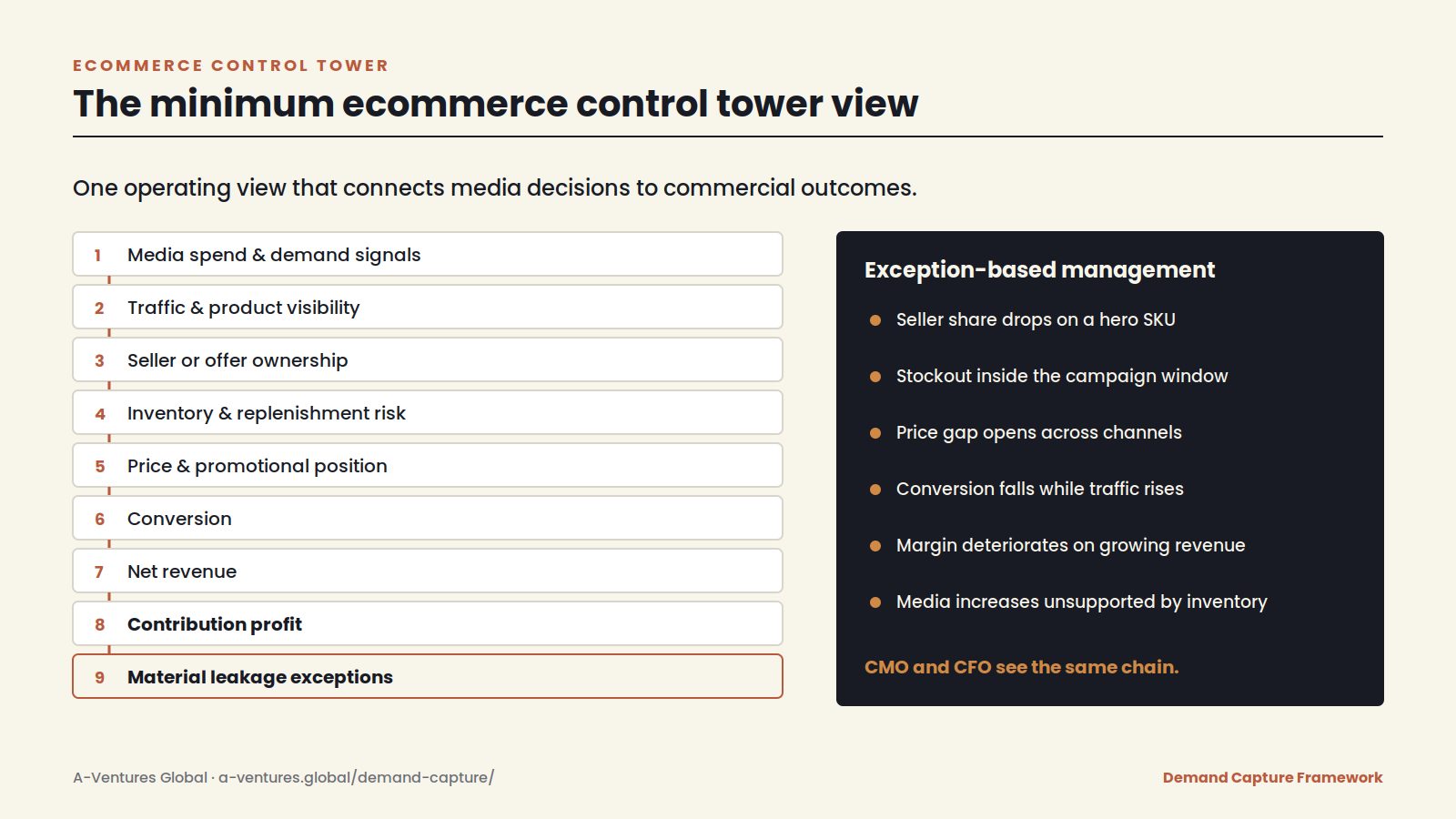
A useful control tower should make the following chain visible.
- Media spend and demand signals
- Traffic and product visibility
- Seller or offer ownership
- Inventory and replenishment risk
- Price and promotional position
- Conversion
- Net revenue
- Contribution profit
- Material leakage exceptions
Organize around decisions, not data sources
Do not reproduce every metric available from every platform. Begin with the decisions executives and operators need to make: should we increase media; should we move inventory; should we resolve a seller issue; should we change price or promotion; should we pause a campaign; which SKU is leaking the most value?
Then expose only the data required to make those decisions confidently.
Use exception-based management
Executives do not need to review every SKU every morning. Build thresholds that surface exceptions: unexpected seller-share changes, impending stockouts, large price gaps, sudden conversion declines, margin deterioration or media increases unsupported by inventory.
Exception-based management makes the control tower operational rather than informational.
Connect the CMO and CFO
The most valuable control-tower design creates a common line of sight between marketing outcomes and economic outcomes. The CMO should be able to see whether demand is converting through intended channels. The CFO should be able to see whether that growth is producing acceptable contribution profit.
That shared view changes the conversation from "Did the campaign hit ROAS?" to "Did the investment create profitable, controlled growth?"
A-Ventures' role
A-Ventures' operating model starts by determining what is happening, what technology is needed, and where intervention creates value, across market trends, product mix, advertising, seller control, inventory, revenue, margin and returns. The control-tower framework turns those capabilities into an executive operating model rather than a collection of point tools. The Demand Capture Ledger is A-Ventures' own system of record for this view.
The advantage is integration: media and commerce signals are more valuable when they explain one another.
Start small
A control tower does not need to begin as a major systems integration. Start with a small number of priority brands, channels and SKUs. Align definitions. Create a weekly exception review. Prove that the combined view changes decisions and economic outcomes. Then automate and scale. The Demand Capture Audit is a good first weekly review.
Frequently asked questions
It is an operating view that connects media, marketplace, seller, inventory, pricing, conversion and profit signals so teams can manage demand capture.
A dashboard reports metrics. A control tower is designed around cross-functional decisions, exceptions and actions.
Only metrics needed to manage demand capture: demand signals, seller ownership, inventory, pricing, conversion, revenue, contribution profit and leakage indicators.
Ecommerce, marketing, supply chain, finance and executive teams managing material digital-commerce revenue.
Sources and further reading
Related
Part of the A-Ventures demand capture framework. See also: commercial leakage, contribution profit, Demand Capture Audit.
Work with A-Ventures on demand capture
The Demand Capture Ledger measures, at the SKU level, how much of the demand your advertising creates is captured by the authorized channel, dollarizes the leakage, and deploys the fix. It is delivered by Equity Commerce, an authorized WPP service provider, inside your existing agency relationship. Name a client and a category and we will bring the numbers.