
Answer first
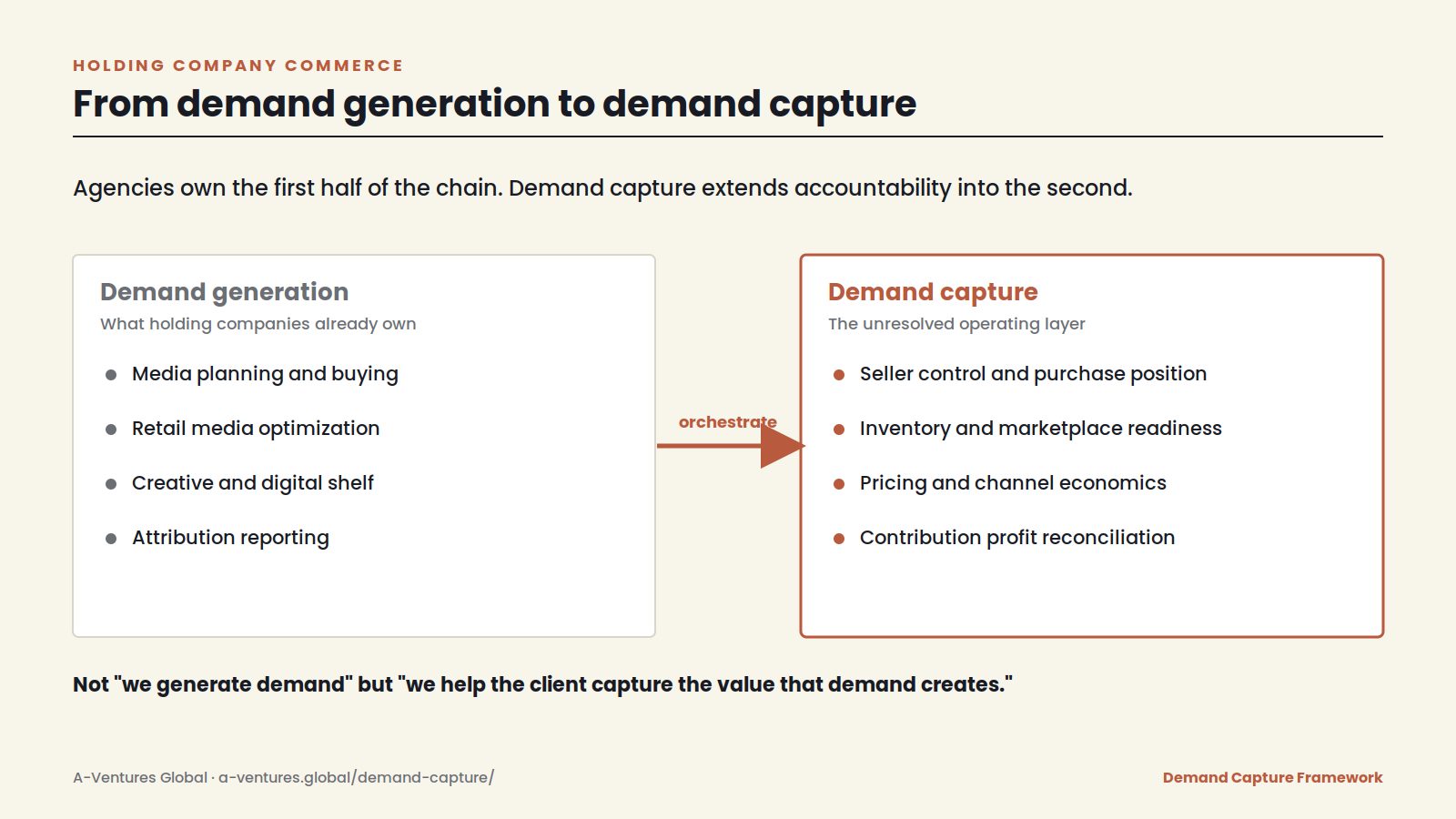
Holding company commerce can extend beyond media. Advertising holding companies can take responsibility for the operating conditions that determine whether media-created demand becomes profitable client revenue. The opportunity is not simply to add another ecommerce agency. It is to connect media, seller control, inventory, marketplace readiness, attribution and contribution economics into one demand capture system.
The market is already moving
Major holding companies increasingly describe commerce as an integrated growth capability. WPP positions commerce across media, creativity, technology and measurable retail growth. Omnicom has expanded Flywheel around connected commerce and retail media. Havas has added ecommerce and retail-media capabilities through acquisition.
The strategic direction is clear: agency groups are moving closer to transactions and business outcomes.
The unresolved operating layer
Even when an agency can plan media, optimize retail advertising and improve digital-shelf execution, a harder question remains: who actually captures the transaction the agency helped create?
If the intended seller is out of stock, an unauthorized seller controls the purchase position, pricing is misaligned or fulfillment economics are poor, the agency can deliver a strong media result without delivering the full commercial result. That gap is media leakage.
Demand capture expands accountability
A demand-capture model gives agency leaders a way to connect marketing performance to the client's commercial environment. Before a major campaign, the agency and brand can conduct a readiness audit. During activation, they can monitor seller share, inventory and pricing through an ecommerce control tower. Afterward, they can reconcile attributed sales with brand-captured revenue and contribution profit.
Why Tier 2 brands are especially attractive
Brands in the roughly $50 million to $500 million revenue range often have sophisticated agencies but comparatively fragmented commerce infrastructure. They may need marketplace monitoring, retail-media optimization, inventory forecasting, catalog management, pricing intelligence, attribution and profitability analysis without having the scale to build separate internal teams for each capability; see the mid-market commerce stack.
This creates a practical opening for holding companies to orchestrate a commerce ecosystem around the client.
A new holding company commerce model for agencies
Commerce can broaden the agency revenue model beyond media and creative fees. Potential services include managed marketplace operations, retail-media optimization, channel control programs, marketplace expansion, analytics, technology orchestration and performance-linked commercial services where appropriate.
The stronger value proposition is outcome-based: not only "we generate demand," but "we help ensure the client captures the value created by that demand."
What agencies should not do
Holding companies do not need to own every operational capability or take inventory risk to participate. The better model may be orchestration: combine agency media and client leadership with specialist technology, marketplace operations and analytics partners that can fill the operating gaps.
The A-Ventures wedge
A-Ventures' differentiated role is the operating ecosystem between demand generation and revenue capture. That includes the technology and operating capabilities required to understand seller control, marketplace readiness, inventory, profitability and cross-channel execution, delivered through Equity Commerce, an authorized WPP service provider, inside the agency's existing client relationship.
For agency leadership, the proposition is straightforward: you already manage substantial investment creating demand. Build the commercial controls that help your clients capture more of the value you create.
Frequently asked questions
Clients increasingly expect measurable business outcomes, and media, retail data, marketplaces and transactions are becoming more tightly connected.
It is the discipline of connecting media-created demand to the seller, inventory, channel and economics that ultimately produce client revenue and profit.
Not necessarily. They can orchestrate specialist operating and technology partners while retaining the client relationship, media integration and outcome measurement.
Brands with meaningful media investment and marketplace complexity but insufficient internal commerce infrastructure are especially strong candidates.
Sources and further reading
Related
Part of the A-Ventures demand capture framework. See also: media leakage, ecommerce control tower, channel control, the mid-market commerce stack.
Work with A-Ventures on demand capture
The Demand Capture Ledger measures, at the SKU level, how much of the demand your advertising creates is captured by the authorized channel, dollarizes the leakage, and deploys the fix. It is delivered by Equity Commerce, an authorized WPP service provider, inside your existing agency relationship. Name a client and a category and we will bring the numbers.