
Answer first
A $50 million to $500 million consumer brand typically needs many of the same ecommerce capabilities as a global enterprise, but cannot justify separate teams, integrations and software contracts for every function. The right ecommerce technology stack therefore emphasizes integrated decision-making, not the maximum number of tools.
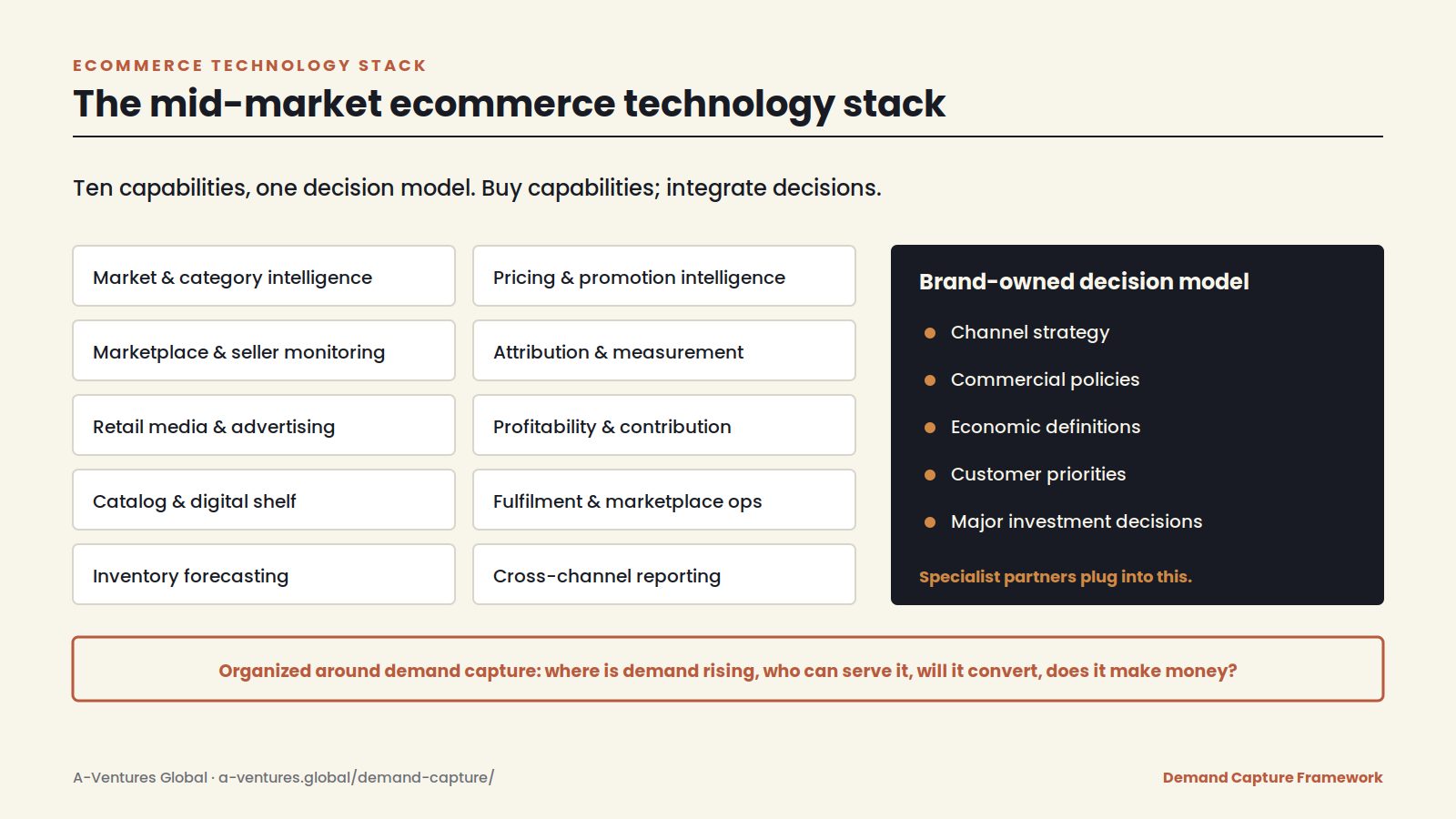
The mid-market ecommerce technology stack problem
Growing brands quickly accumulate point solutions. One tool manages retail media, another monitors marketplaces, another forecasts inventory, another manages content, another tracks profitability, and spreadsheets bridge the gaps.
Each tool may be useful. The failure occurs when the organization cannot connect the signals. Advertising decisions ignore inventory. Seller monitoring does not affect media. Profitability is calculated after the fact. Operators spend time reconciling definitions rather than improving economics.
The capabilities a mid-market stack needs
Most brands in this revenue range need capabilities across the following layers.
- Market and category intelligence
- Marketplace and seller monitoring
- Retail-media and advertising optimization
- Catalog and digital-shelf management
- Inventory forecasting and replenishment visibility
- Pricing and promotion intelligence
- Attribution and measurement
- Profitability and contribution economics
- Fulfillment and marketplace operations
- Cross-channel executive reporting
Buy capabilities, integrate decisions
The strategic question is not whether every capability should be built internally. It is which decisions the brand must control and which capabilities can be delivered through specialist partners.
A-Ventures is a commerce technology studio that invests in, aggregates and operates ecommerce technology, intelligence and operating capabilities. That model is particularly relevant to mid-market brands because it reduces the burden of evaluating, integrating and managing a growing set of specialized tools, and because each tool is proven inside live enterprise engagements before it is offered.
Avoid the "one more tool" trap
Adding a new point solution should require a clear answer to three questions: what decision will improve; what existing data must connect to it; and who will act on the signal?
If those answers are weak, the new software is likely to create reporting rather than operating value.
Organize the stack around demand capture
A more useful architecture starts with the commercial outcome. To capture demand profitably, the brand needs to know where demand is rising, whether the intended seller can serve it, whether inventory is available, whether content and pricing will convert it, and whether the final transaction makes money.
That sequence should determine the integration roadmap. It is the sequence behind demand capture, marketplace readiness and contribution profit, and it is what an ecommerce control tower makes visible.
What should remain internal?
Brands should retain ownership of channel strategy, commercial policies, economic definitions, customer priorities and major investment decisions. Specialist technology and operating partners can supply data, tooling and execution, but they should plug into a brand-owned decision model.
The right end state
The best mid-market commerce stack does not resemble a large-enterprise org chart. It gives a smaller team enterprise-grade visibility and operating control without recreating every capability internally.
The test is simple: can the brand see where demand is being created, where it will convert, who will capture it, whether inventory can support it and what contribution profit it will produce?
Frequently asked questions
At minimum, capabilities for marketplace visibility, advertising, catalog, inventory, pricing, attribution, profitability and operations, with enough integration to support cross-functional decisions.
Usually the better question is which strategic decisions must remain internal and which specialized capabilities can be assembled through partners and existing platforms.
Functions buy tools independently, data definitions diverge and integrations lag behind the growth of the business.
Prioritize tools that improve a material commercial decision and can connect to the brand's demand-capture operating model.
Related
Part of the A-Ventures demand capture framework. See also: ecommerce control tower, marketplace readiness, contribution profit.
Work with A-Ventures on demand capture
The Demand Capture Ledger measures, at the SKU level, how much of the demand your advertising creates is captured by the authorized channel, dollarizes the leakage, and deploys the fix. It is delivered by Equity Commerce, an authorized WPP service provider, inside your existing agency relationship. Name a client and a category and we will bring the numbers.