
Answer first
Marketplace readiness is the condition in which a brand's product, seller, inventory, pricing, content and fulfillment environment is prepared to convert incremental consumer demand. Media should scale after marketplace readiness is established, not be used to compensate for operational weaknesses.
Why media cannot fix marketplace fundamentals
Advertising can increase visibility and traffic. It cannot reliably solve an out-of-stock product, a weak product detail page, an unintended seller controlling the transaction, a suppressed listing, a pricing conflict or poor fulfillment availability.
When those conditions exist, more media can amplify the problem by sending more shoppers into a commercial environment that is not ready to convert them. The result is media leakage.
The marketplace readiness checklist
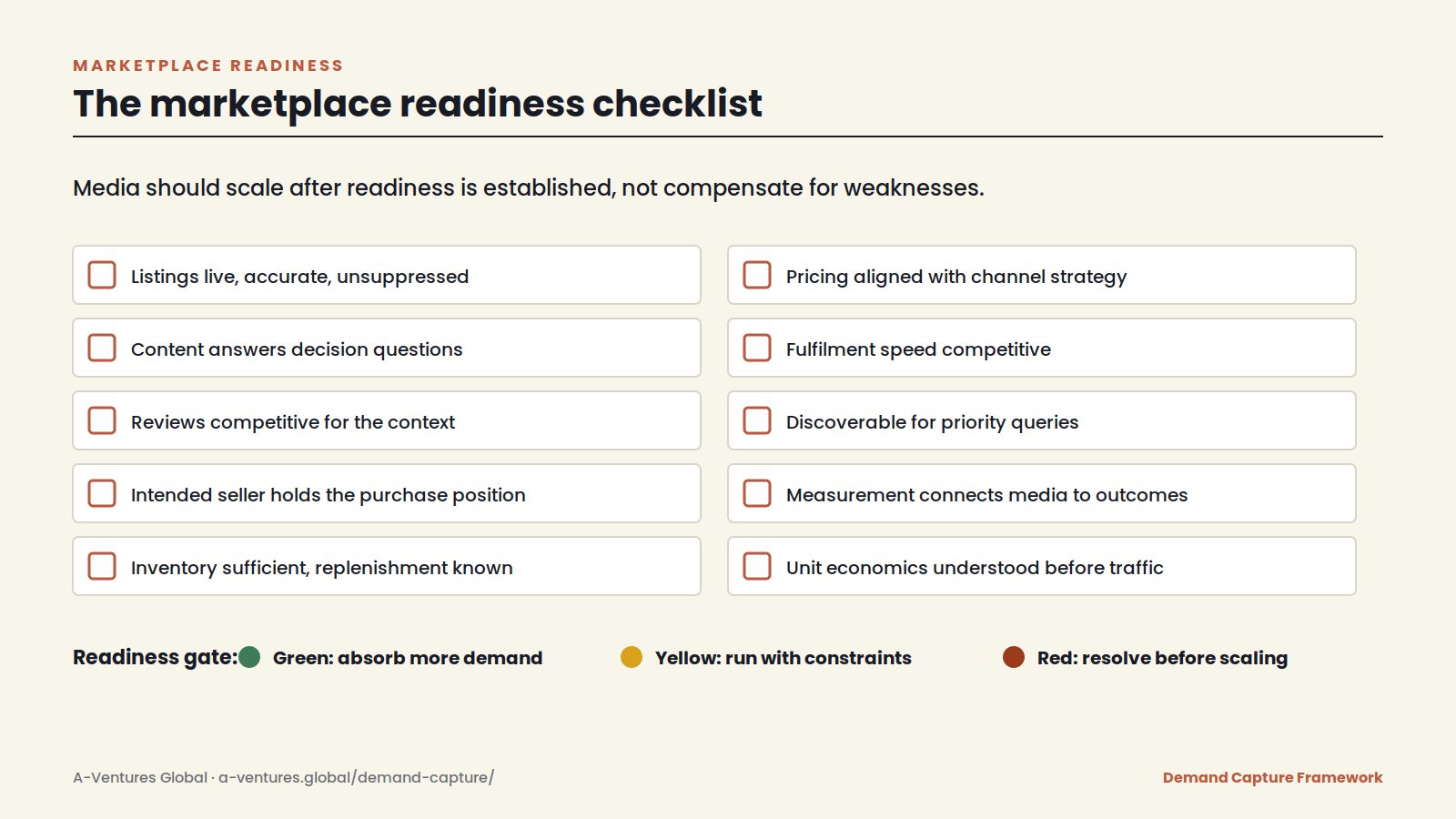
Before a major campaign, confirm the following conditions.
- Product listings are live, accurate and free of known suppression or compliance issues.
- Titles, images, attributes, descriptions and enhanced content accurately answer the shopper's decision questions.
- Ratings and reviews are sufficient for the competitive context and major customer objections are understood.
- The intended seller or channel is positioned to receive the transaction; see channel control.
- Inventory is sufficient for expected campaign demand and replenishment timing is known.
- Pricing and promotions are aligned with the wider channel strategy.
- Fulfillment speed and availability are competitive.
- Search discoverability is adequate for branded and priority non-branded queries.
- Measurement is configured so the brand can connect media signals to marketplace outcomes where tools allow.
- Unit economics are understood before incremental traffic is purchased.
Readiness is SKU-specific
A brand can be marketplace-ready overall while a hero product is not. Evaluate readiness at the SKU and channel level, especially for products receiving material media support.
This prevents average portfolio metrics from hiding a high-risk launch or campaign.
Use readiness gates
A-Ventures recommends a practical traffic-light gate. Green products can absorb more demand. Yellow products can run with identified constraints and monitoring. Red products should not receive a material step-up in paid demand until the critical defect is resolved.
The gate should be commercial, not bureaucratic. The point is to avoid paying to reveal problems that could have been fixed before the campaign. The Demand Capture Audit is the structured version of this gate.
Connect readiness to forecasting
Marketplace readiness changes over time. A product that is ready today may become vulnerable if inventory falls, price competition changes or new sellers appear. Media planning should therefore use forward-looking inventory and seller signals rather than a one-time launch check.
What readiness unlocks
When marketplace fundamentals are strong, media teams can optimize against a cleaner system. Conversion signals are more meaningful, inventory can support demand, and the organization can distinguish creative or targeting issues from operational failures.
Marketplace readiness does not guarantee campaign success. It removes preventable commercial friction so media performance has a fair opportunity to translate into profitable brand revenue, which is the whole point of demand capture.
Frequently asked questions
Marketplace readiness means the product, seller, inventory, pricing, content and fulfillment environment is prepared to convert incremental demand.
Sometimes, but material risks should be explicit. Critical seller, inventory, listing or economic defects should usually be resolved before a major increase in paid demand.
It is cross-functional across ecommerce operations, supply chain, marketing, channel management and finance.
Before major campaigns and launches, with ongoing monitoring for high-velocity or media-supported SKUs.
Related
Part of the A-Ventures demand capture framework. See also: Demand Capture Audit, channel control, media leakage.
Work with A-Ventures on demand capture
The Demand Capture Ledger measures, at the SKU level, how much of the demand your advertising creates is captured by the authorized channel, dollarizes the leakage, and deploys the fix. It is delivered by Equity Commerce, an authorized WPP service provider, inside your existing agency relationship. Name a client and a category and we will bring the numbers.