
Answer first
Commercial leakage is the economic value lost between consumer demand and profitable brand capture. It includes transactions diverted to unintended sellers or channels, revenue lost to availability and conversion failures, and margin lost through pricing, fees, fulfillment or poor channel economics.
Why commercial leakage is hard to see
Most organizations measure functions separately. Media teams measure campaign efficiency. Marketplace teams monitor listings and sales. Supply-chain teams monitor inventory. Finance reports margin. Commercial leakage appears in the gaps between those systems.
A brand can therefore report healthy advertising, strong category demand and growing marketplace sales while still losing value through seller displacement, stockouts, price erosion or unfavorable unit economics. media leakage is the part of this loss that begins with a successful campaign.
The six common leakage zones
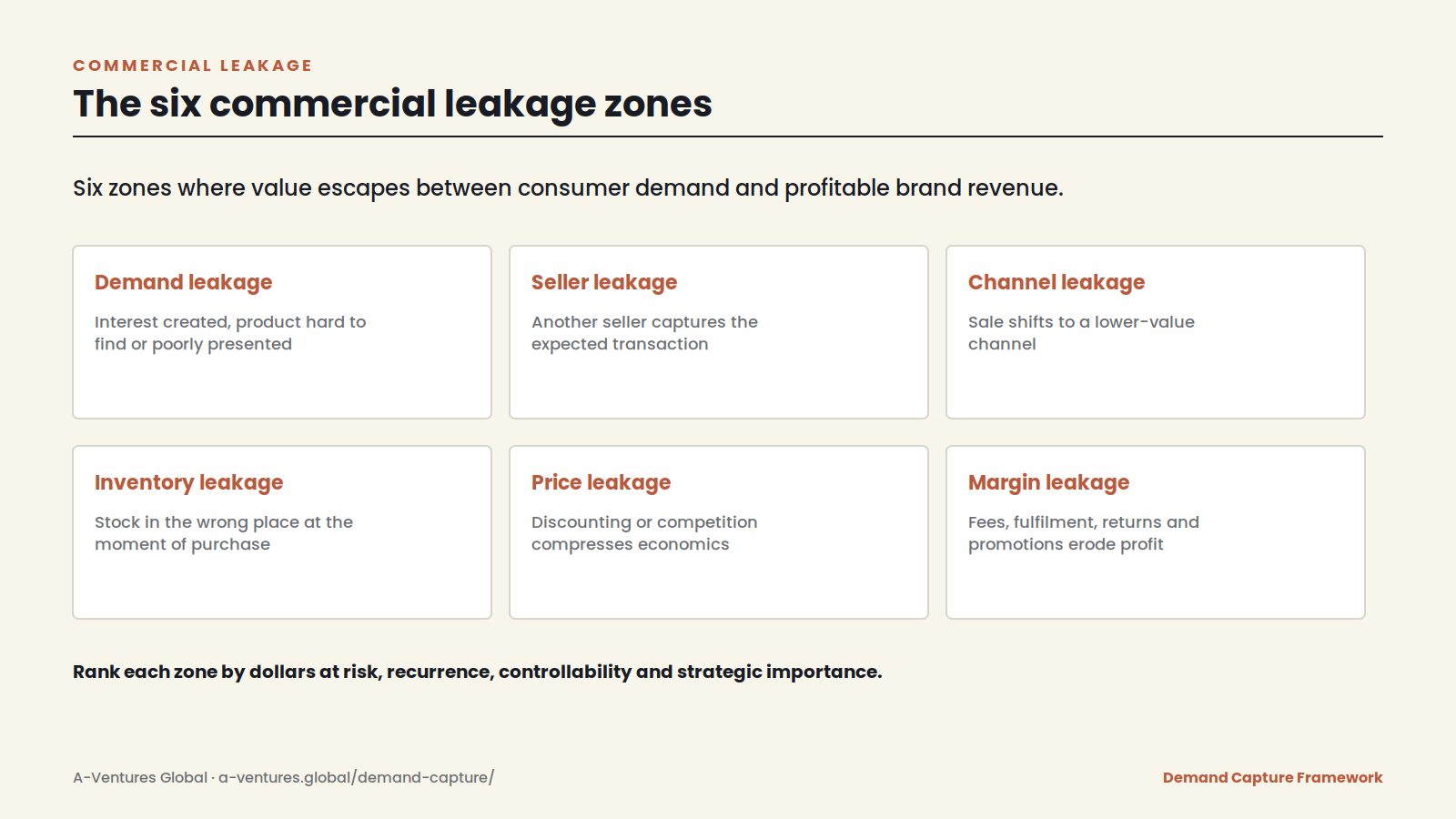
Commercial leakage usually appears in six zones.
- Demand leakage: consumer interest is created but the product is difficult to find, unavailable or poorly presented.
- Seller leakage: another seller captures the transaction the brand expected to own.
- Channel leakage: the sale shifts into a channel with lower strategic or economic value.
- Inventory leakage: demand cannot be served because inventory is in the wrong place or unavailable at the moment of purchase.
- Price leakage: discounting, inconsistency or marketplace competition compresses realized economics.
- Margin leakage: fees, fulfillment, returns, promotions or operational costs make apparently successful revenue less profitable than expected.
Leakage is a system problem
Treating each leakage type as a separate vendor problem creates another form of fragmentation. Seller-monitoring software may detect an unauthorized seller. Inventory software may forecast a stockout. Advertising software may optimize bids. Finance may calculate contribution margin. The decision value comes from seeing the relationship between those signals.
If paid demand is rising while brand inventory is falling and third-party seller share is increasing, the combined pattern matters more than any single dashboard. That is the job of an ecommerce control tower.
How to quantify leakage
Start with observable transactions and controllable causes. Estimate the sales volume associated with unintended sellers, stockout periods, suppressed or non-converting listings, material price gaps and channel shifts. Then translate that volume into lost net revenue and contribution profit where possible.
Do not manufacture precision. A range that identifies a $2 million to $3 million annual problem is more useful than a false $2,417,381 estimate built on weak assumptions.
Prioritize leakage by economic impact
Not every operational defect deserves equal attention. Rank leakage using four factors: dollars at risk, recurrence, controllability and strategic importance of the affected product or channel.
A temporary content defect on a low-volume SKU may be less urgent than a persistent seller-control problem on a hero product receiving millions of dollars in media support.
Create a commercial leakage register
A mature demand-capture program maintains a recurring register of leakage risks. Each item should include the affected channel and SKU, leakage type, estimated economic exposure, evidence, owner, corrective action and status.
That makes leakage visible to executives without requiring them to inspect every marketplace exception.
The objective is profitable capture
Commercial leakage is not a mandate to centralize every ecommerce decision or eliminate all channel variation. Some channel differences are intentional. Some third-party distribution is valuable. Some promotions are economically justified.
The objective is to distinguish intentional economics from unmanaged loss. A-Ventures' approach is to make the commercial system explicit so brands can decide where they want demand to convert, measure whether that is happening, and intervene when value escapes unintentionally. That is what demand capture means in practice, and channel control is where most of the fixes live.
Frequently asked questions
Commercial leakage is economic value that is lost between consumer demand and profitable brand revenue because of seller, channel, inventory, pricing, conversion or margin failures.
Revenue leakage is part of it. Commercial leakage is broader because it also includes margin erosion and situations where revenue is captured in a less valuable channel or by an unintended seller.
By economic impact, frequency, controllability and strategic importance rather than by the number of operational exceptions.
No. The goal is to identify material, preventable leakage and distinguish it from intentional channel economics.
Related
Part of the A-Ventures demand capture framework. See also: media leakage, channel control, contribution profit, ecommerce control tower.
Work with A-Ventures on demand capture
The Demand Capture Ledger measures, at the SKU level, how much of the demand your advertising creates is captured by the authorized channel, dollarizes the leakage, and deploys the fix. It is delivered by Equity Commerce, an authorized WPP service provider, inside your existing agency relationship. Name a client and a category and we will bring the numbers.